

For the second consecutive year, Park Güell has joined the BSM and UPC project to promote scientific vocations outside the classroom, especially among girls
The students, from schools near the park, put their knowledge of mathematics, science, art, and technology into practice while exploring Gaudí's work
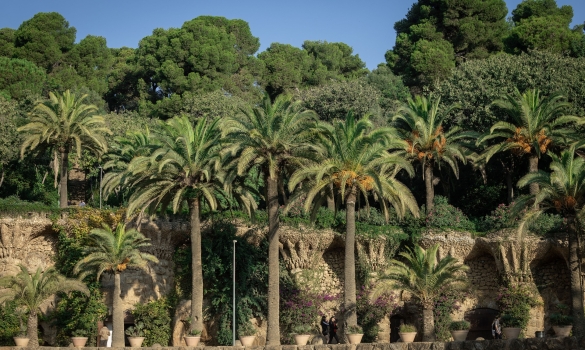
Park Güell hosted the second edition of STEAM Park Güell on Wednesday, organised by Barcelona de Serveis Municipals (BSM) and the East Barcelona School of Engineering (EEBE) of the Polytechnic University of Catalonia – BarcelonaTech (UPC).
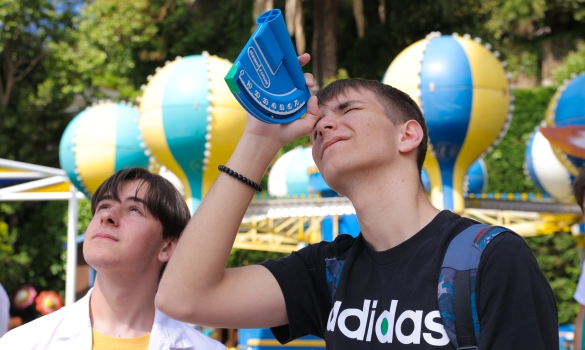
Throughout the morning, around five hundred 5th- and 6th-year primary school students from schools near the park took part in various workshops and activities, where they applied their knowledge of science, technology, engineering, arts, and mathematics, while exploring the history and works of Gaudí. All with the aim of developing skills from the scientific curriculum based on a different perspective, helping to inspirescientific vocations among younger students.
The students discovered the practicality of Gaudí's catenary arches by building one themselves; they designed and constructed a model of a dome to cover the Plaça de la Natura; and they explored the significance of structures, both in architecture and the human brain. They also enjoyed a discovery activity in the monumental area of Park Güell and a dance performance inspired by the geometric shapes used by Gaudí.
Close to 8,000 students will take part in STEAM activities organised by BSM and the UPC this school year
Over the course of the year, six STEAM days are planned, organised by BSM and UPC, taking place in iconic Barcelona locations such as Zoo de Barcelona, Park Güell, the Anella Olímpica, Parc del Fòrum, and Tibidabo. A total of 7,750 students are expected to take part, 10% more than last year.
The next event in this STEAM series will take place on 12 December at Zoo de Barcelona, with around five hundred 1st- and 2nd-year ESO students taking part. Students will have the opportunity to explore different aspects of biology and environmental knowledge in a fun and interactive way. They will do this, for example, by extracting DNA from a strawberry, experimenting with how what we consume is converted into energy, and by observing at firsthand how the brain and muscles communicate.
The next event after that will be held at the Anella Olímpica on 18 March, when the Palau Sant Jordi will become a true laboratory for 2nd- and 3rd-year ESO students. There they will learn, among other things, how the brain works, the reasons behind certain chemical reactions, and the importance of discovering new materials.
Just a few days later, on 26 March, Parc del Fòrum will take over to provide another large-scale scientific testing ground, in this case for 4th-year ESO and baccalaureate students. Participants will experiment with the way light travels, the acidity of liquids and Ohm’s law, among other topics. In addition, aspects of urban mobility will be addressed for the first time at the event, using the Municipal Tow Truck and its contribution to public spaces as an example.
The final STEAM event of the school year will be held at Tibidabo on 14 May. This year, the amusement park will host another edition of Fisidabo, a huge physics festival organised in collaboration with the Physical Engineering undergraduate programme at the UPC’s School of Telecommunications Engineering (ETSEIB), in which 4th-year ESO and baccalaureate students will put their knowledge into practice by conducting experiments on the park’s various rides.