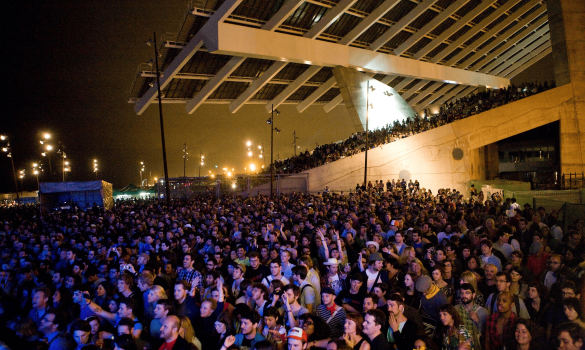


For 2026-2028, contracts to hold late-night music festivals at Parc del Fòrum will be awarded by public tender, increasing the number of promoters who can bid
The Primavera Sound and Cruïlla festivals will continue to be governed by the current rules, as they are held under their own specific processes
All bidding procedures will include mandatory measures for music promoters in relation to events’ acoustic impact, safety from a gender perspective, sustainability, social return for the local area and payment of fees for special Guàrdia Urbana city police, Fire Brigade and cleaning services
Activity will not increase, instead remaining at current levels: 15 days for musical events during times earmarked for cultural activities and 15 days for concerts finishing after 11 pm
Barcelona City Council will introduce new regulations for music festivals at Parc del Fòrum to improve harmony with local residents and enhance the positive impact of these activities on surrounding neighbourhoods, in an effort to balance local residents’ demands with the needs of the music industry.
In the three-year period from 2026 to 2028, music events will thus be awarded by public tender, increasing the number of promoters who can apply. Activity will not increase, instead remaining at current levels: 15 days for musical events during times earmarked for cultural activities and 15 days for concerts finishing after 11 pm. Furthermore, Friday concerts will have to finish by 1 am to allow event-goers to take the metro home and local residents to rest.
The new rules will not apply to city events held at Parc del Fòrum, such as the Cruïlla and Primavera Sound festivals, which are governed by their own regulated processes based on city-wide criteria and whose contracts are still in force. Putting these events out to tender will therefore open up new possibilities for nine days of small and large late-night music festival events. The new process for awarding these contracts also facilitates one of the changes the music industry has been calling for: the ability to plan in the medium term, improving the logistics and performer recruitment services.
In addition, both the City Council and BSM, the municipal company that runs Parc del Fòrum, will strive to gradually spread out events over the year, particularly during the high season (spring and summer), and ensure that music events are not held on consecutive weekends.
New acoustic impact, mobility, safety, sustainability and local benefit obligations for bidders
Under the new bidding procedures, music promoters will also be subject to new requirements.
Their event plans will have to include noise studies and measures to address noise from event-goers between the Parc del Fòrum and public services and crowded spaces. They will also have to submit a specific safety protection plan from a gender perspective (with details of purple points, safe routes at night, etc.), a sustainability plan, with measures such as using environmentally friendly plates and cups, and a plan for social return to the local area, including, for example, recruiting volunteers or additional staff or hiring young people or vulnerable individuals as part of job placement programmes.
They will also be required to hold meetings with local resident associations and representatives and pay specific fees to cover special municipal services, including those provided by the Guàrdia Urbana, the Barcelona Fire Brigade and cleaning staff.
Building on existing work
These initiatives seek to protect local residents’ right to rest and peace and quiet while addressing the music industry’s needs. Certified acoustic control systems are already in operation at Parc del Fòrum 24/7/365. These systems monitor noise levels both on stage and in the venue’s interior and immediate surroundings to ensure that the maximum permitted levels are not exceeded.
Music event promoters are already required to submit an acoustic impact plan with a simulation of immission levels in the buildings closest to the venue. They are also subject to other requirements, such as orienting the stage in accordance with regulations to minimise the acoustic impact of events on the surrounding area, installing officially approved sound limiters and submitting a report after the event with details of the sound levels recorded.
The social harmony and safety measures include increasing the number of Guàrdia Urbana officers and access control staff. Furthermore, specific routes have been established in the area to ensure that everyone is able to get around, help event-goers reach public transport and avoid large crowds passing by people’s homes.
Cleaning services will also be increased for events, with additional cleaning outside the venue after each event, focusing on the routes taken by event-goers to reach public transport. Other measures include closing and hosing down the areas outside the venue to prevent overcrowding around it, possible closures of the Ernest Lluch entrance towards Eduard Maristany to prevent crowds in nearby residential blocks, and special measures for residential blocks adjacent to the Fòrum.
The mobility measures to be put in place during major events include, among others, cheaper underground parking for motorcycles, special shuttle services and late-night timetables for the TRAM on weekdays that are not public holidays, and arrangements with the city’s taxi service.
Social return for the local area
Parc del Fòrum also supports initiatives to benefit the local area.
For example, a total of 524 young people from El Besòs i el Maresme neighbourhood were hired in 2024 in partnership with organisations and promoters of the events held at Parc del Fòrum.
Parc del Fòrum also promotes sustainability through initiatives such as using 100% certified green energy, electrifying its entire fleet of vehicles, holding fossil fuel-free events and using groundwater for non-drinking water purposes at food and drink outlets. These initiatives reduce the venue’s CO2 emissions by 100 tonnes, and save over 60,000 litres of water per year.