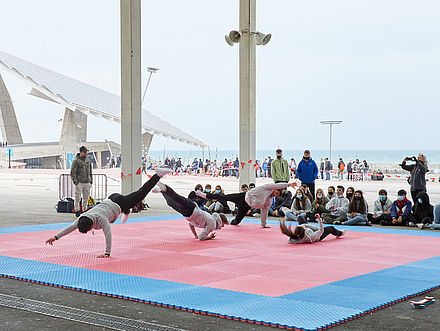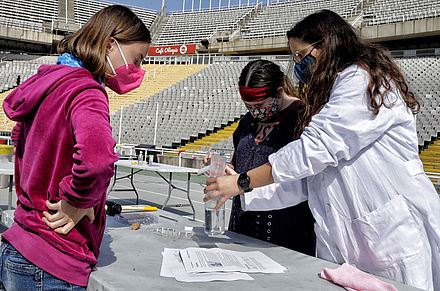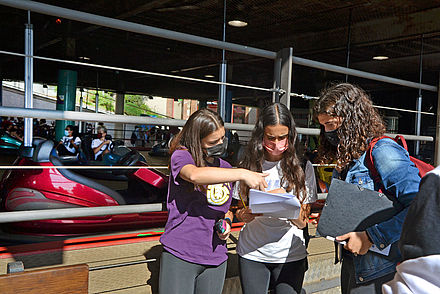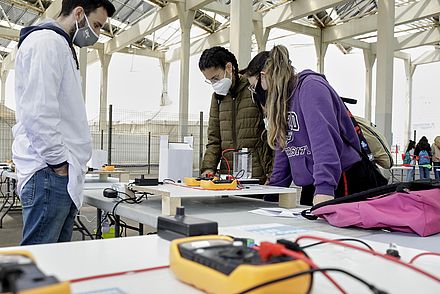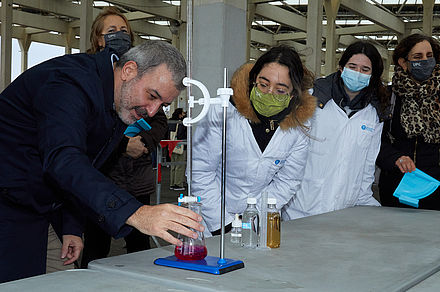


The two organisations are working together to promote scientific vocations among teenagers, by means of STEAM workshops (Science, Technology, Engineering, Arts and Mathematics)
For the first time, Barcelona Zoo has been added to the list of emblematic venues used as STEAM experimentation centres: the Fòrum Park, the Olympic Ring and Tibidabo
Over the last four years, 11,000 students have taken part in the project, which endeavours to break down gender stereotypes and highlight leading women, in order to foster scientific vocations among girls
Among other experiments, students can build a rocket driven by pressurised water, understand the importance of sustainable-mobility models, thanks to Bicing, or study the concepts of acceleration, velocity and force on Tibidabo’s roller coaster
The first activity, Visions STEAM – Fòrum, was held today. It is aimed at 4th year and sixth form secondary school students
Barcelona is becoming established as an educational-innovation hub at a European level. A new season of STEAM activities (Science, Technology, Engineering, Arts and Mathematics) begins today. It is being jointly organised by Barcelona de Serveis Municipals (B:SM) and the Polytechnic University of Catalonia - BarcelonaTech (UPC), at various emblematic locations in the city. The aim is to help foster scientific vocations among compulsory secondary education and sixth form students, especially girls, providing knowledge in a flexible, creative way while maintaining academic rigour.
This year, nearly 6,000 students are taking part in the various activity sessions that have been scheduled. The registration figures show the participation of 2,800 more students than last year, when the total capacity was reduced because of the pandemic.
In the last four years, over 11,000 compulsory secondary education and sixth form students have taken part in STEAM activities, which until this year were held in three of the city’s emblematic locations: the Olympic Ring, the Fòrum Park and Tibidabo Amusement Park. This year, Barcelona Zoo will also be hosting workshops and activities. This means that, for the first time, 1st year secondary school students can also take part. With this expansion, the project now covers all compulsory secondary education and sixth form courses.
Jaume Collboni, Barcelona City Council’s First Deputy Mayor and president of B:SM, underlined ‘the city’s commitment to science and projects like STEAM, which places us in the vanguard of educational innovation. We aim to offer young people, and especially girls, the opportunities arising from scientific training, thereby ensuring that they take an active part in the technological revolution’. He also emphasised the role played in this initiative by the city’s emblematic venues, the Fòrum, the Olympic Ring, Tibidado and, for the first time, the Zoo. ‘We turn iconic Barcelona facilities into urban “laboratories” for experiencing science and instilling vocations, thereby contributing to the students’ education’, he affirmed.
Adriana Farran, the director of the Barcelona Est Engineering School (EEBE), noted that ‘for the EEBE, it is a pleasure to collaborate in the organisation of Visions – STEAM Fòrum, because, as a polytechnic centre, we have an invested interest in encouraging girls and boys to take up science and technology. We believe that one of the best ways to do this is through experience. And if this can be done outdoors, in a dynamic, fun way, so much the better’.
An educational innovation hub at the service of the city’s young talent
All the project STEAM activities are prepared in line with the educational curriculum of each school year. Using a cross-cutting approach, subjects which are difficult to explain inside the classroom due to their level of complexity are chosen, turning them into fun experiments to make them easier to understand. In addition to promoting scientific and technological culture, the activities offer multi-disciplinary perspectives on a given subject, creating a dialogue between scientific methods and creative processes. This also contributes to educational innovation in the classroom.
During the activities, the students taking part are accompanied by monitors, who are also UPC students. Many of these young people participated in the design of the experiments, together with professors Luis Carlos Pardo and Artur Paz, who are the UPC’s project coordinators. It is therefore a session made by and for students, something which facilitates the learning experience still further.
We foster scientific vocations in emblematic city venues
The project is structured around four different formats, held in four city venues specialising in the various educational stages.
Visions STEAM is the result of a collaboration between B:SM and the UPC’s Barcelona Est Engineering School (EEBE). Visions STEAM – Fòrum was the first session to be held, and it took place today. 4th year secondary school students carried out experiments involving biology, physics, mathematics, chemistry and technology. This year, B:SM has given grants to 60 students from the Barri Besós school, covering all of their expenses, so that they could take part in the activity. This is another social return and integration initiative, aimed at generating synergies with the Fòrum Park area and revitalising the neighbourhood.
Visions STEAM – Olympic Ring is being held soon (7 April). This session is aimed at 2nd and 3rd year secondary school students. The session’s various itineraries are structured along five lines: brains, material, energy, art and technology. Among other experiments, the participants can build a rocket powered by pressurised water, experience Newton’s Laws through dance, understand the importance of sustainable-mobility models, thanks to Bicing, and take part in a laser game based on an episode of The Big Bang Theory.
Some time later, on 9 November, it will be the turn of Visions STEAM – Zoo, which is being held for the first time. In this case, the activity is aimed at 1st and 2nd year secondary school students. This means that, for the first time, all secondary school years can now benefit from this series of activities.
Fisidabo 2k, the precursor of the STEAM project
Fisidabo 2k (20 May) focuses on physics and is organised in collaboration with the Physical Engineering Degree Course at the UPC’s Higher School of Telecommunications Engineering (ETSEIB). It is aimed at 4th year compulsory secondary education and sixth form students, who will have the chance to transform some of the Park’s attractions, in order to carry out experiments, thereby getting a first-hand learning experience.
The planned experiments include: confirming Newton’s Second Law using the movement of El Diavolo’s flying chairs; calculating the acceleration, velocity and power of the roller coaster, studying the dynamic force of El Piratta, and establishing why the mirrors in Miramiralls reflect images in different ways. The Fisidabo Labshow is being held on the Sunday of the same week as Fisidabo. Students and researchers will demonstrate science to families, by using various shows and workshops.
This is the fifth year of Fisidabo 2k’s great school activity, learning from the experience of Fisidabo Hipàtia, which is celebrating its 10th anniversary. Fisidabo Hipàtia is a session where the students themselves, in this case from the CELLEX Science and Mathematics International Baccalaureate, plan and carry out their own experiments, also using the Park’s attractions.
In previous editions, two of these projects had an international projection, being published in the renowned European magazine, the Journal of Physics. Some of the participants in Fisidabo Hipàtia are currently studying in prestigious universities, such as the MIT in Massachussets, the KTH in Stockholm and Swinburne University in Australia.
Some of them explain their experience at Fisidado in this video (in English).
International recognition for B:SM’s and the UPC’s STEAM activities
The B:SM's and the UPC’s STEAM activities have been recognised internationally in various scientific, technological and educational areas. The Fisidabo 2K project and the STEAM-Olympic Ring project won accolades in the ‘Physics and Society’ category of the 2018 ‘Science in Action’ awards, a nationwide competition for students, teachers, researchers and communicators in the scientific community. The main aim of these awards is to present science in an attractive, motivating way for young people and the general public.
In 2015, the Fisidabo 2k project took part in the international ‘Science on Stage’ fair for educational initiatives in London. That experience was a key factor in establishing contact with similar educational initiatives in other parts of Europe.