

The construction of a BSM car park at the Mercat del Peix, as part of the Ciutadella Knowledge Hub, has enabled the recovery of 40,000 m3 of sand, which will be used to replenish Sant Sebastià beach through a joint initiative between Port de Barcelona and BSM
The construction of the new Districlima cooling plant at Bogatell also involves the recovery of an additional 8,000 m3 of sand, which will be deposited on Llevant beach and in the dune area of Mar Bella beach
The recovery of sand during coastal works and its subsequent strategic distribution are measures that help safeguard the city's beaches and enhance their resilience against sea storms
These sand recovery and replenishment measures are aligned with the goals of the Climate Plan, the municipal government's roadmap, which includes a €1.8 billion investment to make Barcelona a more resilient and carbon-neutral city by 2030
Three beaches in Barcelona will be replenished with 48,000 m3 of sand sourced from two projects on coastal land. First, the construction of the BSM car park at the old Mercat del Peix, as part of the Ciutadella Knowledge Hub, has yielded 40,000 m3 of sand. Meanwhile, the construction of the new Districlima cooling plant at Bogatell has extracted an additional 8,000 m3 of sand. The sand will be distributed across Sant Sebastià beach, a measure carried out by Port de Barcelona in collaboration with the City Council, as well as Llevant beach and Mar Bella beach.
The construction works for the Mercat del Peix, one of the five strategic projects that will make up the Ciutadella Knowledge Hub, have uncovered large amounts of high-quality sand, particularly during the excavation process for the future BSM Ciutadella Knowledge Hub car park. This car park will be situated directly beneath the planned research and innovation complex, which is set to be built on the site of the former market, between the streets Wellington, Villena, Ramon Trias Fargas streets, and Avinguda Icària.
This sand, of high quality, is commonly found beneath the Barcelona coastline and originates from the sedimentary deposits of the Quaternary period. The sand, having passed all quality tests and analyses, will be deposited on Sant Sebastià beach, which is protected by the Sant Sebastià breakwater. This structure, extended by Port de Barcelona, helps prevent sand loss from the beach.
The proximity of the car park construction site to the beach, about 2 kilometres, will also mitigate the environmental impact of the transport. The project is expected to take around two months and will affect part of the promenade and the bike lane.
The second project which has also enabled the extraction of high-quality sand is the new Districlima cooling plant, currently under construction near Bogatell beach, which will expand the existing heating and cooling network. This type of infrastructure supports the city's progress in the energy transition, positioning it as a key producer and manager of its own resources. It allows for the use of local energy resources, waste recovery, and the use of renewable and residual energy sources. In addition, for these kinds of infrastructure, proximity between the energy generation source and consumption centres represents a major advantage in planning energy self-sufficiency in urban spaces.
This project has recovered 8,000 m3 of sand, which will mainly be placed on Llevant beach, one of the areas most affected by marine storms in the city. Additionally, sand will be added to the dune area of Mar Bella beach, one of the critical points for beach erosion. This project is expected to last approximately one month.
The sand on the beaches plays a clear role in protecting the coastline from marine storms. Municipal teams have calculated that the city's beaches lose around 30,000 m3 of sand annually, and certain areas of the beach lack sufficient sand to provide adequate protection for the coastline as well as the infrastructure, such as drainage systems, the promenade, lifeguard towers, showers, and furniture.
Measures to progress towards the goals of the Climate Plan
Both the Mercat del Peix and Districlima projects are initiatives that will contribute to achieving the goals outlined in the Climate Plan, particularly in terms of sustainable mobility and the energy transition.
» A new car park model that meets the evolving needs of the public
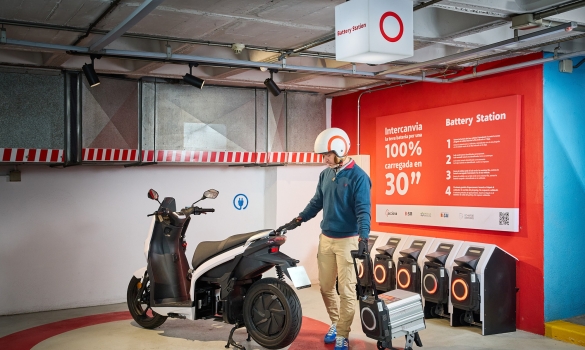
The new BSM Ciutadella Knowledge Hub car park, spanning over 6,000 m2, will be the first to be designed as a genuine mobility hub, both in terms of the services it will offer and its architecture and design. This new parking concept goes far beyond vehicle parking, integrating value-added services that respond to new habits and social needs, such as online shopping, electric mobility, and shared mobility.
At the level of construction, this new conceptualisation involves a much more open definition of space, with flexible-use areas and higher ceilings that allow the entry of all types of vehicles.
The construction of the BSM Ciutadella Knowledge Hub car park will involve a total investment of €22.2 million, with €10.7 million provided directly by BSM, and the remaining amount provided by other participating operators.
» Sustainability, one of BSM's core lines of action
Sustainability is one of BSM's global strategic lines. In accordance with its aim of making Barcelona more sustainable, the company takes an environmental, social and good governance approach to all its experiences and activities.
This commitment can be seen in its promotion of actions designed to reduce emissions and the use of resources, and also have a positive social impact, as well as in the sustainable management of all its premises.
BSM has received many seals and certificates for its commitment to sustainability. In the field of responsible tourism, the Anella Olímpica, Park Güell, Barcelona Zoo and Tibidabo have the Biosphere certificate, which is awarded to companies committed to environmentally friendly management models that also ensure a social return on their activities.
Furthermore, BSM's activities are backed by its SGE21 certification, which includes environmental, social and good governance aspects; ISO 14001 certification, which validates environmental management; and the certificate awarded under the European EMAS regulation on eco-management and auditing.
» Third Districlima plant, reinforcing the city’s heating and cooling networks
The new Districlima plant, with an investment of €44.4 million, is located in the Poblenou district. This network, which currently has two operational plants, one located at the Fòrum and the other on Carrer Tànger, helps prevent the emission of approximately 26,000 tonnes of CO2 into the atmosphere each year.
Districlima is a public-private company founded in 2002 to introduce, for the first time in Spain, an urban network for the distribution of heating and cooling, used for heating, refrigeration, and domestic hot water. In 2005, the network was extended to the 22@ technological district, and the construction of a third plant has now commenced.
Heating and cooling networks offer significant energy efficiency improvements compared to individual systems. It is an energy-efficient system that also saves water, reduces noise, lowers vibrations, minimises CO2 emissions, and cuts maintenance costs.
Connecting new buildings to these networks is beneficial for climate and environmental purposes, as it is seen as a preferable alternative to other cooling and heating systems. The city currently features the Districlima network, serving the Forum and 22@ areas, alongside the Ecoenergies network, which operates in the Marina del Prat Vermell area and includes a planned extension in La Sagrera.