

The Olympic Port is undergoing a transformation which aims to achieve maximum sustainability, accessibility and high quality economic activity.
The new hub for the blue economy is becoming a reality now that the night-life venues there have been removed, creating 250 jobs in a space of more than 7,800 m2.
The first change will be a new access point directly connecting the seafront with the new areas at the Olympic Port.
The 9,000 m2 revamp of the sea wall area will turn it into a vantage point, looking out to sea.
The start of this new works project comes after the completion of the maritime works, which will help to recover the area's marine biodiversity and protect the port from storms.
The project to transform the new Olympic Port and turn it into a focal point for the city marches on, with work to make it a more accessible space for the public and to drive economic activity, with more areas to stroll in, the recovery of the seabed and a new vantage point looking out to sea. The new lease of life for the port has been fuelled by an investment of 28 million euros since last February.
New access to improve connectivity between the Olympic Port and the city
The first measure in 2020 was the recovery of the 44 night-life venues at the Moll de Mestral wharf, creating 13,000 m2 of space for people to stroll in and pursue sport. This process should change the Olympic Port into a new meeting point for social interaction and families in Barcelona.
This was a key step for starting the most significant work that now follows; the direct link between the Olympic Port and the city with a new access point from Av. Litoral.
The new connection ensures a permeable space, doing away with barriers and differences in levels to generate continuity with the Olympic Village and the Olympic Port itself.
Work is set to start in March 2022 and entails an investment of 2.74 million euros.
The former night-life wharf becomes an icon for the blue economy in the city, generating quality new jobs
One of the underlying strategies for the Olympic Port is to promote a new model of economic activity based around the blue and circular economy linked to the sea, making the environmental conservation of aquatic ecosystems compatible with social and economic development.
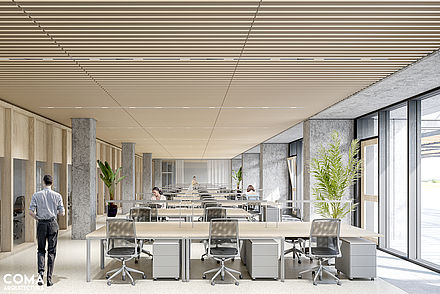
This new model will include an anticipated surface area of 7,800 m2, allowing for productive, sustainable and innovative daily activity to turn the Olympic Port into a living port, 365 days a year, and a hub for economic activity linked to the sea.
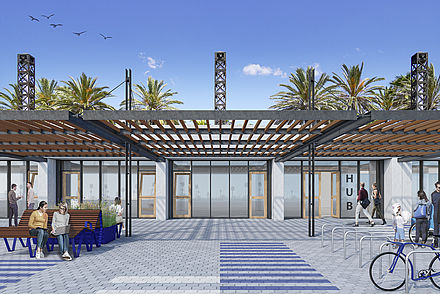
At the Moll de Mestral wharf, where the night-life venues were previously located, a space of 4,000m2 will be devoted to companies in the field of popular nautical activities, sport and innovation. There will also be a space for promoting the circular economy.
Various facilities will also be available, such as a meeting hall for 150 people and various annexes equipped with an innovative sustainable temperature control system that takes advantage of the thermal gradient using seawater.
Finally, a new promenade will be built at the Moll de Mestral for visitors to enjoy, with green areas and shade provided by a large pergola made from sustainable local materials.
The rest of the spaces devoted to the blue economy will be located at the sea wall and the Moll de Marina wharf, accounting for the other 3,800 m2 of space.
New sea viewing point for Barcelona
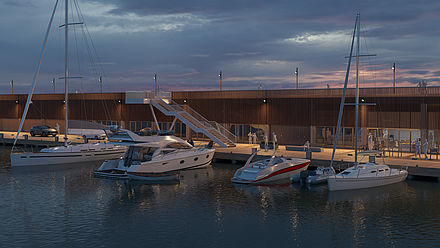
With the main storm-protection work and measures to recover the biodiversity of the seabed completed at the sea wall, this structure will now be transformed into a large accessible viewing platform, integrated with the city.
The upper part will be revamped with spaces for people to stroll in, with a new ramp and various steps. At sea level, the former premises and storage units will offer different services relating to nautical activity.
This work entails a space of nearly 9,500 m2 and an investment of roughly 8.3 million euros. Work gets under way in May 2022 and is expected to be completed in the first four months of 2023.
Reorganisation of mooring points: safer and better service
Work began on the anchoring system at the Olympic Port in January. The goal is to improve safety for boats and comfort for users, as some elements suffer wear and tear over time due to weather conditions and the weight of the vessels.
The mooring cable system has also been replaced by a double-cable one to facilitate manoeuvring and avoid cables getting stuck.
This work has enabled the mooring points to be reorganised to adapt their dimensions and guarantee that current boat widths are catered for. The fleets at the Marina, Mestral and Gregal wharfs have therefore been reorganised by type and according to the needs of users, improving safety, comfort and practicality of use, with more space for each vessel.