

The Sahel Discovery Centre is opening a new interpretation trail to offer visitors an exciting experience which will improve their knowledge of this bioregion
New signs feature two types of information aimed at children and adults
The new communication strategy means the trail has been conceived as a route from the Atlantic Ocean to the Red Sea
The Sahel Discovery Centre at Barcelona Zoo has opened a new interpretation trail to offer visitors an exciting experience which will improve their knowledge of the Sahel Savanna bioregion.
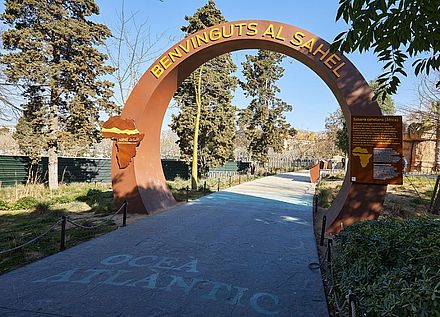
The new communication strategy means the trail has been conceived as a route from the Atlantic Ocean to the Red Sea. The route begins in Senegal and ends in Eritrea, passing through six other countries on the way. Visually appealing signs provide educational content along the way, helping visitors to experience an authentic journey through the Sahel as they make their way around.
The bioregion is represented at the zoo through a uniform set of enclosures housing animals from this habitat, which is highly vulnerable owing to the climate emergency. The Zoo is committed to preserving the region's biodiversity and is involved in various projects to reintroduce animals in danger of extinction back into the wild, aware of their importance for the planet. This is a region with strong ties to the Mediterranean at an ecological level, in terms of climate flows and species migration.
The overall goal of the discovery centre is to have a positive impact on the situation of the wildlife, the natural habitats and the traditional ways of life associated with this large bioregion, such as that of the nomadic Peul people. To achieve this, the interpretation trail includes the following elements:
- A large entrance arch, which invites people to discover the space and provides basic visual information about the bioregion, along with another arch at the other end of the trail.
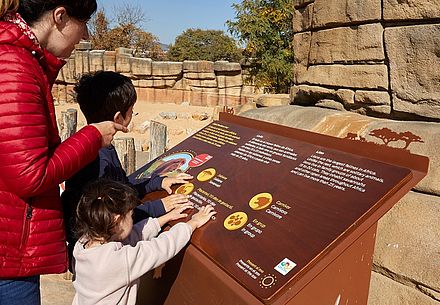
- Throughout the trail, two information panels give an initial explanation of the habitat and the species that live there.
- The section for each species includes two educational signs, one for children and one for adults.
- At the end of the route there is a sign asking members of the public to get more involved in conservation, including calls to action.
- Two sets of markings on the floor help recreate the geographical location and sensation of a continental journey: waves lapping the shore, identified as the Atlantic Ocean and the Red Sea respectively at the two arches, plus signs showing the name of each country as visitors cross the Sahel.
These elements make up the first phase of the rollout of this interpretation trail, which will be completed early in 2023.
In line with its new model, Barcelona Zoo is rolling out a comprehensive communication strategy to make the visit a complete experience, rather than simply the observation of a set of enclosures with animals. The aim is to open the door to new knowledge and, most of all, move people and inspire them to act. The overall goal is to have a positive impact on the situation of the region's wildlife and natural habitats.
This strategy seeks to reach as many people as possible and is based around four main areas: Effective transmission of information (for visitors to take an interest), conservation (all spaces must be connected with a conservation goal), action (to give visitors hope and the tools for resolving the problems explained) and excitement (the whole Zoo experience needs to be exciting to generate empathy).
The information offered is aesthetically coherent. It is distributed throughout the different sections to reinforce the feeling of really exploring nature and pays attention to the personal stories of the animals. The emphasis is also on empowering adults, who receive important information on conservation which they can then convey to children, who also receive content which has been adapted to make it more attractive.
Interpretation at today's zoos
Zoos such as those in Berlin, Hamburg, the Bronx, Washington and San Diego are international leaders for the high level of public awareness they have managed to achieve through interpretation centres. By reflecting this model, Barcelona Zoo is to gradually include new elements and discovery centres, following the example of the Sahel centre.
Interpretation trails in zoos are determined by the fact that most visitors do not have an in-depth knowledge of biology and ecology. To get members of the public interested in the conservation of biodiversity, these discovery spaces need to be based on specific and spontaneous experiences with animals. Installations must attract the attention of the visitor and generate an interest in interpretation features. To be effective, these must be able to answer the questions asked by each individual, and then introduce new ideas.