Imagen destacada
Imatge
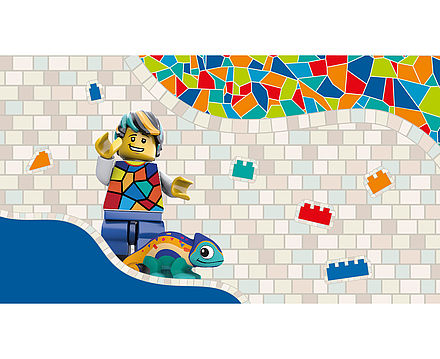
The Park Güell animation made from pieces of LEGO
Cuerpo

Over 750 children aged between 7 and 12 are expected to take part, building LEGO models inspired by Gaudí's architecture

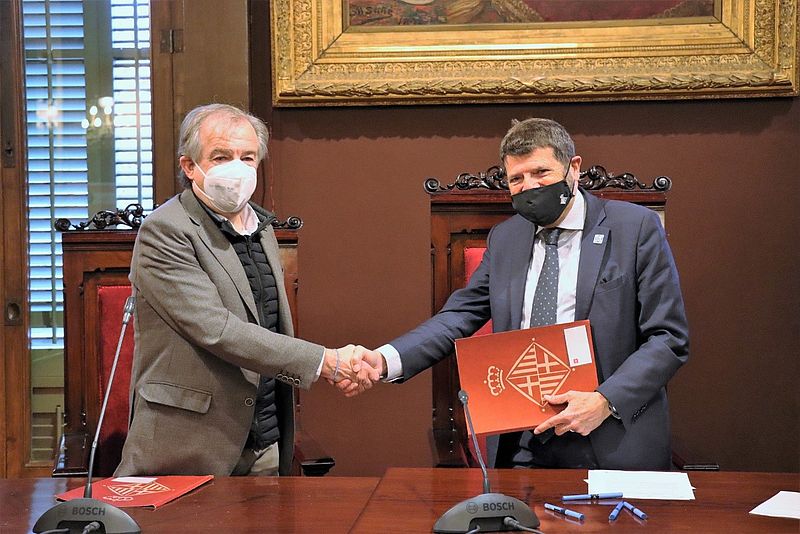
Barcelona de Serveis Municipals (B:SM) and LEGO have signed a collaboration agreement for disseminating Park Güell’s artistic value and Antoni Gaudí’s Modernista architecture. As a result of this alliance, every weekend this May LEGO educational workshops will be held at Casa Jaqués, aimed at kids between 7 and 12 years of age. More than 750 children are expected to take part.

Two separate workshops are being held. On Saturdays, participants will be able to build their own Gaudi-inspired panel using classic LEGO pieces. On Sundays, the workshop will focus on mosaics, and kids will be able to create a small design, also using LEGO pieces, based on one of Antoni Gaudí’s architectural symbols: trencadís [broken-tile mosaics].      

The workshops will last roughly 30 minutes and take place between 11 am and 1 pm. The maximum number of people for each group will be 24. Tickets can be booked, as of 11 April, from the Park Güell official website and will cost €3.

The collaboration agreement between B:SM and LEGO also includes Park Güell's presence in the shop that the Danish brand has in Passeig de Gràcia de Barcelona, where a model will be on display, made with LEGO pieces, of the Park’s entrance pavilions.
 

Park Güell offers educational workshops on Gaudí and Modernisme through LEGO
Read the note
Fecha de publicación
News or press release?
Press release
Imagen destacada
Imatge
Students sitting on the grass of the Lluis Companys Stadium, listening to one of the Olympic Ring STEAM activities
Cuerpo

Visions STEAM – Anella is the school year’s second STEAM (Science, Technology, Engineering, Arts and Mathematics) workshop, following the one held at the Parc del Fòrum two weeks ago

Barcelona de Serveis Municipals (B:SM) is working on this project alongside the Polytechnic University of Catalonia · BarcelonaTech (UPC), with the aim of promoting a vocation for science among teenagers and breaking gender stereotypes  

Students have had the chance to experience Newton's laws through dance, understand the importance of sustainable mobility models thanks to Bicing and take part in a laser game based on an episode from the series The Big Bang Theory.

Visions STEAM – Anella was held this Thursday at the Lluís Companys Olympic Stadium. The stadium was turned into an experimentation centre where 1,600 second- and third-year secondary education students were able to carry out a series of activities associated with the STEAM (Science, Technology, Engineering, Arts and Mathematics) culture. Organised jointly by Barcelona de Serveis Municipals (B:SM) and the Barcelona Est School of Engineering (EEBE) at the Polytechnic University of Catalonia · BarcelonaTech (UPC), this project is aimed at promoting a vocation for science among teenagers.

It also aims to break down stereotypes and encourage a science vocation among girls, by highlighting women scientist role models. The project's goal is to equip students with knowledge through fun experiments. Materials that are harder to work with in the classroom because of their complexity are chosen to encourage a flexible and creative approach, while maintaining full academic rigour.

The activities carried out in this latest edition were organised into five areas: brain, matter, energy, art and technology. Each one involving three different activities, supervised by monitors, supplemented with a dossier for working on knowledge. Students were able to take part in experiments such as building a rocket propelled by pressurised water, experiencing Newton’s laws through dance, understanding the importance of sustainable mobility models thanks to Bicing and a laser game based on an episode from the series The Big Bang Theory.

A project that positions the city as a centre for educational innovation

Visions STEAM – Anella is part of a very extensive educational project made up of four activity days. Visions STEAM Fòrum was held at Parc del Fòrum on the 23 March for fourth-year ESO and baccalaureate students, enabling them to carry out experiments in the fields of biology, physics, mathematics, chemistry and technology. This school year’s second activity day, Visions STEAM – Anella, was held at the Olympic Stadium on Thursday. The Fisidabo 2k will be held on 20 May, giving fourth-year ESO and baccalaureate students an opportunity to turn Tibidabo Amusement Park’s attractions into an experimentation centre. 

A new feature this year, Visions STEAM – Zoo, for 1st- and 2nd-year ESO students, will be held for the first time on 9 November. That means all secondary-education years will be covered, from 1st-year ESO to 2nd-year baccalaureate. So around 6,000 teenagers are expected to benefit from STEAM activities in 2022.


1,600 second- and third-year secondary education (ESO) students turn the Olympic Stadium into a STEAM experimentation centre 
Read the note
Fecha de publicación
News or press release?
Press release
Imagen destacada
Imatge
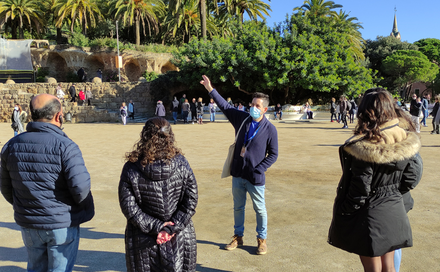
An official Park Güell guide explaining something to three visitors, as part of the guided tour service
Cuerpo

The Park is offering guided tours throughout Easter week, open to everybody and available in four languages

The tours are a great chance to learn about the Park’s history and discover its hidden secrets

Park Güell is resuming its guided tours as from Friday, 8 April, offering them every day over Easter week, through until 18 April. This is a great opportunity for people to come to the park and discover, through specialist guides, the history, symbols and natural and heritage values of this space.

The tour lasts about an hour and takes in the park's most iconic landmarks, giving participants an insight into the secrets of Gaudí’s architecture and connecting with the values of modernisme and the harmony between nature and the park. Tours are available in four languages: Catalan, Spanish, English and French, depending on the day and the time.

The tour costs €22 and includes admission to the park and the services of a specialist guide. Sessions are now on sale and visitors should book in advance on the official website for Park Güell. Visits are conducted in groups of up to 25 people, observing the health and safety protocols at all times.
 

Guided tours resume at Park Güell
Read the note
Fecha de publicación
News or press release?
Press release
Imagen destacada
Imatge
A spider monkey with her offspring
Cuerpo

The Zoo is part of the European programme to protect this monkey in danger of extinction, listed as critically endangered on the International Union for Conservation of Nature’s Red List

The baby monkey is in perfect health and is being protected by its mother at all times 

March saw the birth of a brown spider monkey (Ateles hybridus) at the Zoo, a species in critical danger of extinction according to the Red List from the International Union for the Conservation of Nature. 

Barcelona Zoo is an active participant in the European EAZA Ex-situ Programme (EEP) for endangered species, coordinated by the European Association of Zoos and Aquaria to facilitate the reproduction of this species. “These programmes aim to keep the population healthy and stable at a European level so that some of its members can reinforce natural populations through reintroduction programmes”, explained the Zoo director, Antoni Alarcón. In addition, the programmes seek to provide a vehicle for education to promote and support conservation activities developed in the natural environment. “The new model for the Zoo is committed to the preservation of biodiversity, particularly species like the spider monkey, which are severely threatened”, added Alarcón. 

The baby monkey, whose sex is still not known, is in perfect health and is being protected by its mother Perla at all times. This is Perla’s third baby.  The role of the mother is very important for the rest of the females in the group at this point, who can observe and learn how the baby is looked after. 

Barcelona Zoo currently has a family group of nine individuals, made up of a male, three adult females, one of them at an advanced age, and five younger females born between 2016 and 2019.

The EEP programme for the spider monkey currently consists of a population of 69 individuals: 32 males, 35 females and 2 still to be sexed, housed in 16 institutions. 

The spider monkey, in critical danger of extinction in the wild 

The spider monkey is one of the largest primate species living in South America. It is characterised by a long prehensile tail, which it uses as an additional limb. The species has no thumbs on its hands, helping it to swing with its arms as it tends to get around using tree branches, where it spends much of its time. 

The natural population of this species inhabits the septentrional forests of South America. The population has diminished at an alarming rate in the last 45 years, shrinking by 80%.  The main threats to the species are the disappearance of its natural habitat, through deforestation caused by expanding agriculture and timber companies, as well as illegal hunting, as its meat is prized in many parts of its geographical area. 

Barcelona Zoo sees the birth of a spider monkey, a species in critical danger of extinction
Read the note
Fecha de publicación
News or press release?
Press release
Imagen destacada
Imatge
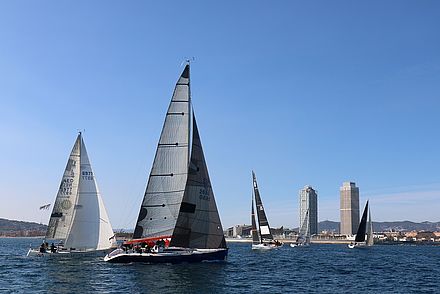
Five sailing boats in the waters of the Olympic Port, on a sunny day
Cuerpo

With 75 boats competing, this is the yacht racing championship with the highest participation in Catalonia 

The regatta consists of four events, organised by the Club de Vela Badalona, the Reial Club Nàutic de Barcelona, the Reial Club Marítim de Barcelona and the Club de Mar Port Olímpic, which will act as the host on this occasion

Nautical activity at the Olympic Port is gaining momentum. The second round of the Barcelona 4 Clubs is being held on Sunday, 3 April, from 12.30 pm. This social yacht racing regatta is jointly organised by the Club de Mar Port Olímpic, the Reial Club Nàutic de Barcelona, the Reial Club Marítim de Barcelona and the Club de Vela de Badalona. 

The event started life in 2017 and is the yacht racing championship with the highest participation in Catalonia, with 75 boats competing.

This second round is organised by the Club de Mar Port Olímpic, which takes over from the Club de Vela de Badalona after the latter organised the first round in February. The championship includes two further rounds on 22 May and 24 September, organised respectively by the Reial Club Nàutic de Barcelona and the Reial Club Marítim de Barcelona.

Boosting nautical activity as one of the strategy areas for the Olympic Port

One key area in the transformation of the Olympic Port involves boosting nautical activity and bringing it closer to citizens. In this new era, the Olympic Port aims to act as a catalyst for activities offered by those based at the facility, developing ties and fostering shared initiatives to help position the port as a setting for regattas and other marine outreach activities.

To achieve these goals, one area of work for the municipal company B:SM involves improving port facilities. Work carried out in recent weeks includes improvements to the mooring chain trench, offering greater safety and ease for vessels and users, as well as the reorganisation of mooring points and the renewal of the mooring chain system. A dredging operation is also under way at the mouth of the port and is set to remove 3,000 square metres of sand from the seabed, adding more depth and ensuring the necessary clearance for boats. Once the sand has been dried, it will be deposited on the Barceloneta beach to help towards the sustainable regeneration of the city coast.  This package of nautical improvements entails an overall investment of 529,228.25 euros. 
 

The Olympic Port hosts the second round of the Regata Barcelona 4 Clubs
Read the note
Fecha de publicación
News or press release?
Press release
Imagen destacada
Imatge
View of the Olympic Port
Cuerpo

The Olympic Port is undergoing a transformation which aims to achieve maximum sustainability, accessibility and high quality economic activity.

The new hub for the blue economy is becoming a reality now that the night-life venues there have been removed, creating 250 jobs in a space of more than 7,800 m2.

The first change will be a new access point directly connecting the seafront with the new areas at the Olympic Port.

The 9,000 m2 revamp of the sea wall area will turn it into a vantage point, looking out to sea.

The start of this new works project comes after the completion of the maritime works, which will help to recover the area's marine biodiversity and protect the port from storms.

The project to transform the new Olympic Port and turn it into a focal point for the city marches on, with work to make it a more accessible space for the public and to drive economic activity, with more areas to stroll in, the recovery of the seabed and a new vantage point looking out to sea. The new lease of life for the port has been fuelled by an investment of 28 million euros since last February.

New access to improve connectivity between the Olympic Port and the city

The first measure in 2020 was the recovery of the 44 night-life venues at the Moll de Mestral wharf, creating 13,000 m2 of space for people to stroll in and pursue sport. This process should change the Olympic Port into a new meeting point for social interaction and families in Barcelona.

This was a key step for starting the most significant work that now follows; the direct link between the Olympic Port and the city with a new access point from Av. Litoral.

The new connection ensures a permeable space, doing away with barriers and differences in levels to generate continuity with the Olympic Village and the Olympic Port itself.

Work is set to start in March 2022 and entails an investment of 2.74 million euros.

The former night-life wharf becomes an icon for the blue economy in the city, generating quality new jobs

One of the underlying strategies for the Olympic Port is to promote a new model of economic activity based around the blue and circular economy linked to the sea, making the environmental conservation of aquatic ecosystems compatible with social and economic development.

This new model will include an anticipated surface area of 7,800 m2, allowing for productive, sustainable and innovative daily activity to turn the Olympic Port into a living port, 365 days a year, and a hub for economic activity linked to the sea.

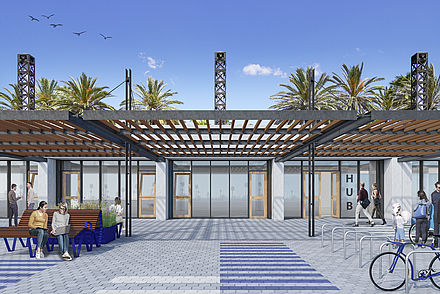
At the Moll de Mestral wharf, where the night-life venues were previously located, a space of 4,000m2 will be devoted to companies in the field of popular nautical activities, sport and innovation. There will also be a space for promoting the circular economy.

Various facilities will also be available, such as a meeting hall for 150 people and various annexes equipped with an innovative sustainable temperature control system that takes advantage of the thermal gradient using seawater.

Finally, a new promenade will be built at the Moll de Mestral for visitors to enjoy, with green areas and shade provided by a large pergola made from sustainable local materials.

The rest of the spaces devoted to the blue economy will be located at the sea wall and the Moll de Marina wharf, accounting for the other 3,800 m2 of space.

New sea viewing point for Barcelona

With the main storm-protection work and measures to recover the biodiversity of the seabed completed at the sea wall, this structure will now be transformed into a large accessible viewing platform, integrated with the city.

The upper part will be revamped with spaces for people to stroll in, with a new ramp and various steps. At sea level, the former premises and storage units will offer different services relating to nautical activity.

This work entails a space of nearly 9,500 m2 and an investment of roughly 8.3 million euros. Work gets under way in May 2022 and is expected to be completed in the first four months of 2023.

Reorganisation of mooring points: safer and better service

Work began on the anchoring system at the Olympic Port in January. The goal is to improve safety for boats and comfort for users, as some elements suffer wear and tear over time due to weather conditions and the weight of the vessels.

The mooring cable system has also been replaced by a double-cable one to facilitate manoeuvring and avoid cables getting stuck.

This work has enabled the mooring points to be reorganised to adapt their dimensions and guarantee that current boat widths are catered for. The fleets at the Marina, Mestral and Gregal wharfs have therefore been reorganised by type and according to the needs of users, improving safety, comfort and practicality of use, with more space for each vessel.

The transformation of the Olympic Port continues with 28 million euros invested to date
Read the note
Fecha de publicación
News or press release?
Press release
Imagen destacada
Imatge
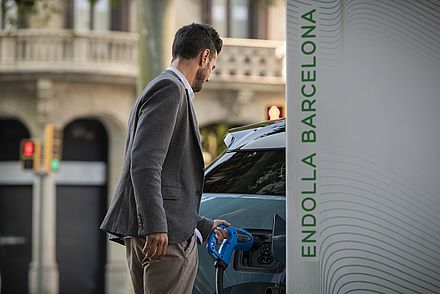
A service user recharging their electric car at an Endolla point
Cuerpo

Awesense won the Tech & Climate call promoted by the Digital Future Society initiative from Mobile World Capital Barcelona

B:SM’s Endolla Barcelona is the biggest public network of charging points in the Spanish state and is among the most extensive in Europe

The pilot project will run during the first four months of 2022

Making headway in efficient energy management is one of the great challenges for new electric mobility, along with the expansion of the EV charging infrastructure throughout the region. To continue making progress in optimising electricity consumption, the Endolla network will be launching the pilot project Awesense Digital Energy Platform, one of the winners of the Tech&Climate 2020 innovation challenge organised by Digital Future Society and Barcelona City Council.

Endolla Barcelona is the biggest urban public network in the Spanish state and one of the most notable in Europe, with 600 charging points located throughout the city (6 points/km2). In addition to fostering the expansion of the service, B:SM is working with the Endolla network to lead e-mobility in the city and become a driving force for the sector, promoting public-private alliances based on knowledge exchange, innovation and added value.

In this context, the alliance between Digital Future Society and B:SM means the Awesense solution will help to ensure the continued study of one of the biggest challenges currently facing the development of e-mobility in Barcelona: smart energy management. Specifically, the Awesense Digital Energy Platform will help optimise energy consumption at Endolla charging points and therefore reduce their environmental impact in the field of mobility.

The pilot test, which is to be deployed over 12 months, is expected to be launched during the first quarter of 2022, and is a further step towards the goal of zero emissions.

A tool for meeting the growth in electric mobility

The Awesense Digital Energy Platform is a tool designed to respond to the growth in sustainable mobility needs in the urban sphere. The application is especially valuable for public service companies and energy suppliers, as it helps them to make use of data-analysis software for establishing the energy systems of the future.

The Awesense technological solution aims to promote a decentralised and decarbonised future for energy, combining energy and geo-spatial data to optimise their efficiency and identify problems by tracing parameters in real time. In B:SM’s case, the tool will enable it to obtain information on the current use of its EV charging infrastructures and to improve its decision-taking on the network’s expansion through the city.

According to Mischa Steiner, CEO at Awesense, "we’re delighted to offer the city of Barcelona an additional vision of its electric vehicle charging infrastructure. This is a great example of the power of data to enable a more accurate vision of analyses. We hope this project benefits the people of Barcelona and improves their access to the electric vehicle charging infrastructure in the near future”.

For her part, the director of Digital Future Society, Cristina Colom, is proud to see how one of the innovative ideas recognised by the Tech&Climate challenge will come to fruition in Barcelona. Colom emphasises that “these challenges help us connect global stakeholders and carry out local initiatives through projects in collaboration with public and private sector partners. The solutions implemented are proof of how technology is the path towards a fair and sustainable society”.  

Marta Labata, CEO of Barcelona de Serveis Municipals (B:SM), notes that “Endolla Barcelona acts as a driving force, a stimulus for electric vehicle penetration in Barcelona. We want to use this leadership well beyond the growth of the public charging point network, where we are already an example in Europe. We also want to actively contribute in terms of innovation, among other aspects, on mechanisms that allow for smart energy management, the object of the collaboration with Awesense. And we’re doing that thanks to public-private alliances and innovative projects”.  

The United Nations 2030 Agenda has defined 17 Sustainable Development Goals (SDGs) and 169 targets, in order to overcome the world’s environmental, economic and social challenges. With projects such as the Awesense Digital Energy Platform, Barcelona is taking another step in the promotion of sustainable mobility. 

Endolla Barcelona electromobility network to optimise energy consumption with the collaboration of Canadian company Awesense
Read the note
Fecha de publicación
News or press release?
Press release
Imagen destacada
Imatge
Panoramic view of the Lluís Companys Olympic Stadium
Cuerpo

The Olympic Stadium will be home to a 1,100 m2 incubation facility, and become the first step towards completing a sports and technology hub in Barcelona

The adaptation work, which will begin in the second half of 2022, has a budget of nearly €2.8 million

The incubator will be launched in 2023, at the end of the first quarter, and it will enable its users to have a privileged relationship with the surrounding sports ecosystem

This February, Barcelona de Serveis Municipals (B:SM) will begin a tender process for adapting the areas of the Olympic Stadium that will be home to the city's first sports start-up incubator, turning the Olympic Ring into an innovation hub for sports and technology.

The project, promoted by B:SM with the collaboration of the Barcelona Institute of Sports and Barcelona Activa, will be located in the former office area located on the southern side of the Olympic Stadium. With a budget of €2.8 million, the space will have a constructed surface area of 1,100 m2 and, among other things, it will be home to a large pre-incubation facility and up to twelve interconnecting work modules. It will also have meeting rooms and other communal spaces for participating companies and entrepreneurs.

The project also includes the adaptation of a 400 m2 outdoors relaxation area. It is located just in front of the offices, and is conceived to help create synergies among the various companies and enable the organisation of outdoor get-togethers and co-creation activities.

The work is scheduled to start during the second half of this year, and finish at the end of the first quarter of 2023. The future management model will be defined during this period.

The physical transformation of the space: the first step towards structuring the Barcelona Sports Hub

The Olympic Ring technological incubator will be the first facility to form part of the Barcelona Sports Hub. The Barcelona Sports Hub is a joint Barcelona Institute of Sports and Barcelona City Council initiative, which aims to provide support for sport as a key area for innovation and one of the city's emerging economic sectors.

The overall objective of the project is to make Barcelona an international benchmark for the exchange of knowledge, talent, resources and innovation skills in the world of technology and sport. The Barcelona Sports Hub will be made up of large corporations, institutions, start-ups and other technological stakeholders that develop projects for the transformation and improvement of the management and practice of sport, including projects related to eSports. With a total budget of €3 million, the hub will be maintained on a digital platform. However, in the future, it is foreseen for it to have physical head offices at the Palau Municipal d’Esports.

The Olympic Ring and Montjuïc: a strategic environment for sports innovation

The Olympic Stadium incubator aims to promote and support the creation of innovative businesses, fostering growth and facilitating the positioning of companies in the city’s business network.

Among other services, it will offer company support and acceleration programmes. It may also act as the promoter of activities in the surrounding sports facilities.

The Olympic Ring offers a strategic environment linked to the practice of sport at a local, national and international level. The companies installed in the incubator will be able to learn and work alongside the sporting events that take place at this privileged location (83 in 2019, before the start of the pandemic).

Furthermore, they will be able to use the Olympic Stadium's facilities to carry out studies, sports tests and experiments, or even hold informative activities and presentations.  

They will also be working in an environment where there are major facilities linked to sport, including the Palau Sant Jordi, the National Institute of Physical Education of Catalonia (INEFC), the Olympic Museum and the Piscines Picornell swimming pools, among other sports installations located in Montjuïc.

First steps for the future sports start-up incubator at the Olympic Stadium
Read the note
Fecha de publicación
News or press release?
Press release
Imagen destacada
Imatge
Tibidabo Amusement Park and CEEB join forces in their commitment to sport and education
Cuerpo

The agreement is aimed at helping to encourage school-age children to play sport with values as a tool for social transformation and growth

On 26 March the Park will hostone of the races on the regular CEEB orienteering calendar.

Tibidabo Amusement Park (PATSA) and the Barcelona School Sports Council (CEEB) signed a collaboration agreement today with the aim of promoting the pursuit of quality sport with values among children at Barcelona’s various schools. The agreement was signed in person by Albert Batlle, the 5th Deputy Mayor at Barcelona City Council and Chair of PATSA, and by Joan Villacampa, the Institutional Deputy Chair of the CEEB, at the Sarrià – Sant Gervasi District head offices.

This partnership is in line with the Park’s educational and sustainability goals, as it will enable students from participating schools to get to know Tibidabo's sustainable environment at first hand by playing sport, as well as encouraging healthy competition among the participants.

One of the key dates for this partnership will be  26 March 2022, when the Park hosts one of the races on the CEEB’s regular orienteering calendar: a cross-county for participants to enjoy sport while looking for landmarks and reconnoitring a space they are not familiar with. The event is aimed at all families, children and adults, regardless of their age.

Tibidabo Amusement Park and CEEB join forces in their commitment to sport and education
Read the note
Fecha de publicación
News or press release?
Press release
Imagen destacada
Imatge
A Bicing user on an electric bicycle
Cuerpo

Once you make a reservation, you will have 5 minutes to go and get a bicycle at the station

The use of electric bikes rose by 90% in 2021, compared to 2020

The last few years have seen the new Bicing model establish itself as one of the safest, healthiest and most sustainable means of transport

Bicing continues to implement new functions to improve user experience for its subscribers. From now on users can reserve an electric bicycle to ensure they have one when they reach their station. Reservations will need to be made using Barcelona’s mobility app, which manages Bicing and many of the city’s other services.

To enjoy this new function, all you need is the latest updated version of smou. Once inside the app it's very easy to make a reservation: just look on the map for your station of origin, click on the reservation button and select which type of bicycle you want, mechanical or electric. Any user who has made a reservation will have 5 minutes to go to the station and collect an electric bicycle.

Reserving a mechanical bicycle is just one of options that was already available to Bicing users through smou, which now has another for reserving electric bicycles. One of the various other functions smou offers is for users to take a bicycle comfortably and safely using a QR code, create routes, geolocate the closest stations and check for bicycle availability

A benchmark in sustainable mobility

Thanks to its new model, Bicing has established itself over the last few years as one of the safest, healthiest and most sustainable means of transport. The last two years has seen the number of km travelled by Bicing users triple, reaching 35 million in 2021. A year that ended with 130,000 subscribers, up by 14% on 2019, before the start of the pandemic. There is a clear upward trend for electric bicycle use, which rose by 90% in 2021 in comparison with 2020, reaching over 5 million journeys a year and now representing more than 36% of all journeys. Each electric bicycle travels an average of 750 km every month, while each mechanical bicycle covers 400 km.


This is a project financed with funds from the Recovery, Transformation and Resilience Plan, financed by European Union – NextGenerationEU.

Logos Next Generation

Bicing enables electric bicycle reservations through the smou app
Read the note
Fecha de publicación
News or press release?
Press release